The problem
“Help me prepare for a fact-finding session at a company I want to work at.”
You are about to meet someone new, at a company you would like to join. You may have nothing in common with them. You do not know whether they are the decision maker for the role you want — or whether they have any say at all. What you actually need from the meeting is not to pitch yourself. It is to find out what the place is like: how it works, how it decides, what its culture feels like from the inside.
Walking in cold wastes the one meeting you get. Walking in with a dossier built from public sources — who this person is, what the company does, what the role really involves, and a short list of questions worth asking — turns a polite chat into a fact-finding session.
This is a recipe: the human version of a prompt. Run it yourself, or paste the prompt below into your own AI assistant and let it do the legwork. Either way, the rules are the same.
New to recipes? Run Verify Your Tool’s Capabilities first if you’re not using a fully connected assistant.
What you give it
- The person’s name and LinkedIn profile. That is enough to start.
- The role posting, if there is one — or the role you have heard about, stated plainly as unconfirmed if you have no posting.
- Your goal for the meeting, in one sentence. In the worked example: interested in the role, unsure whether the person is the decision maker, mainly wanting to understand the culture and how decisions get made.
Where the information comes from
- Sources
- The person’s LinkedIn profile
- The LinkedIn contact-info panel
- The person’s own writing, posts and talks
- The company website
- The careers page
- The job posting
- News and deal coverage
- Anything the person has sent you directly
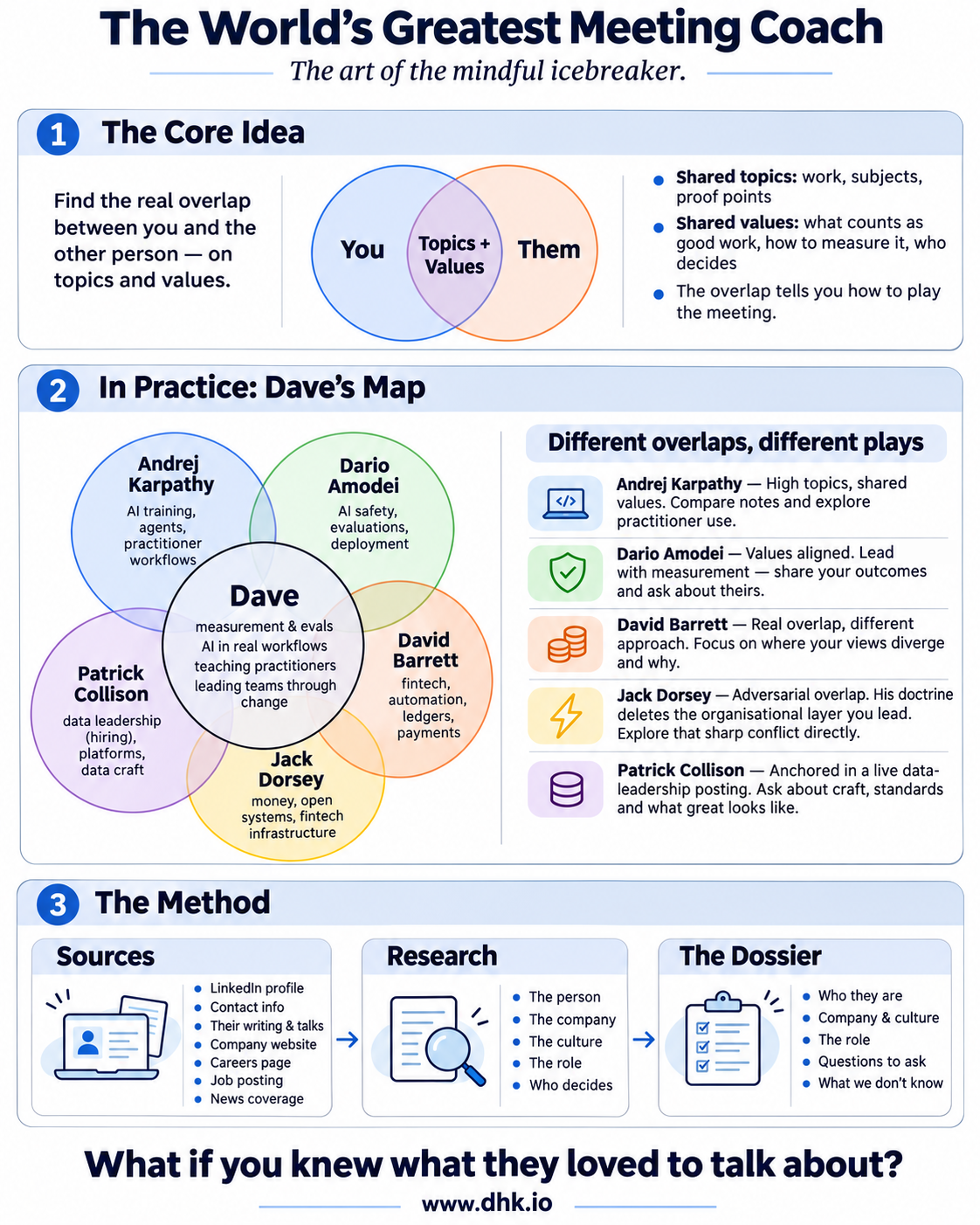
- Research steps
- Person research
- Company and culture research
- Role analysis
- Decision-maker mapping
- Question drafting
- The dossier
- Who they are
- The company and its culture
- The role
- Questions to ask
- What we don’t know
The steps
1. Fix the brief
Write down: who you are meeting, where they work, what role you care about, what you want from the meeting, and what you already know you don’t know.
Done looks like: one sentence each. If you can’t write the goal in one sentence, you don’t have one yet.
2. Research the person
Read their LinkedIn profile properly — career arc, how long in the current role, what they did before. Then open the contact-info panel on the profile: it often surfaces an email, websites and links that appear nowhere else.
Done looks like: you can say who this person is, what they do now, and how they got there, in three sentences — each traceable to the profile.
3. Read the person’s public voice
Find their writing, posts, talks and interviews — Substack, Medium, podcasts, conference talks, their own site. You are looking for what they care about and how they think, in their own words, not a summary of them.
Done looks like: two or three themes, each backed by a link to the thing itself.
4. Research the company
The company website first: what it does, who it serves, how it makes money, how big it is, what stage it is at. Then the careers page — how a company describes working there is a culture document, whether it means to be or not.
Done looks like: you can explain the business to a friend in a minute, and you know what is not public (pricing, headcount, revenue) and have said so.
5. Research the culture
Look for signals beyond the company’s own presentation: news and deal coverage, funding announcements, leadership changes, employee reviews where they exist. A recent acquisition or a new division head changes a culture more than a values page does.
Done looks like: every culture claim is tied to a source. Where the evidence is only the company’s own words, it is labelled thin.
6. Analyse the role
Read the posting like an auditor. Scope, team size, reporting line, comp band, what’s emphasised — and, just as important, what’s missing. No reporting line? No mention of whether the team exists yet? Those gaps become questions.
Done looks like: a short list of what the posting does not tell you. That list is half your question list.
7. Map the decision
From the person’s title and position, form a view on whether they plausibly decide this hire, influence it, or merely know the people who do. Treat it as a hypothesis, never a conclusion — the correct move is to ask, in the meeting, how the decision will actually be made.
Done looks like: one hypothesis, and one direct question that tests it.
8. Draft the questions
Write 6–10 questions you can use verbatim, in this order: culture first, then how the decision gets made, then the role. Questions a person can actually answer from their own experience — not questions designed to show off your research.
Done looks like: you would be comfortable saying every question on the list out loud, in those words.
9. Write down what you don’t know
End the prep with an honest-gaps section: everything material you could not confirm. Unconfirmed role, unpublished salary, invisible internal structure, culture evidence that rests on one source.
Done looks like: the gaps are listed, not papered over. A dossier with no gaps section is a dossier that is guessing somewhere.
10. Assemble the dossier
One to two pages. Five sections: who they are; the company and its culture; the role; questions to ask; what we don’t know. A clickable link on everything — profile, company, careers page, the posting, their writing — so anyone reading it can check any claim in one click.
The rules
- Assume nothing in common. No invented shared history, no manufactured overlap. If a real connection exists and is sourced, it goes in; if not, the prep works without one.
- Never invent. Not a role, not a salary, not a reporting line, not a mutual interest. If it isn’t in a source, it isn’t in the dossier — it goes in the gaps section instead.
- Mark thin evidence as thin. One source, the company’s own marketing, an undated page: say so, next to the claim.
- Every claim traceable to a source. If you can’t point at where a fact came from, it doesn’t ship.
- Links on everything. The reader should never have to take the dossier’s word for anything.
The prompt
Download the skill (SKILL.md), or paste this into your own AI assistant, replacing the bracketed parts:
Build me a meeting-prep dossier on [NAME], [TITLE] at [COMPANY].
I am meeting them about [THE ROLE / THE REASON]. Prepare me as if
we have nothing in common - do not invent overlap, shared history
or mutual interests.

My goal for the meeting: I am interested in the role, I do not know
whether they are the decision maker, and I mainly want to understand
the company's culture and how decisions get made there.

Research, from public sources only:
1. Their LinkedIn profile AND the contact-info panel on it -
   career arc, current role, anything the panel surfaces.
2. Their own writing, posts and talks, wherever published.
3. The company: its website and careers page - what it does, size
   and stage, how it makes money, how it describes working there.
4. News and deal coverage of the company - funding, acquisitions,
   leadership changes - as culture evidence.
5. The role posting, if one exists. If I have only heard about the
   role, say plainly that it is unconfirmed.

Rules: every claim must be traceable to a source, with a clickable
link. Mark thin evidence as thin, next to the claim. If something
cannot be confirmed, do not guess - put it in the gaps section.

Output, one to two pages, in this order:
1. Who they are
2. The company - what it does, and its culture signals
3. The role - scope, what the posting does and does not say, and
   whether this person plausibly decides the hire, stated as an
   open question
4. Questions I can ask verbatim - culture first, then how the
   hiring decision gets made, then the role
5. What we don't know - the honest gaps

Read-only research. Do not contact anyone.
What this recipe does not do
- No outreach. It never messages, emails or connects with the person. Research only.
- No private life. Public, professional sources only — the same things the person has chosen to publish.
- The questions are yours to ask, not scripts to hide behind. The point of the prep is a real conversation. If you read the questions off a page, you have missed the point of having them.
- It does not tell you whether to take the job. It gets you the facts to decide that yourself, in the room.
The worked example
This recipe was run, unchanged, on five people. It produced five different meetings, because the overlap is different every time — shared topics and aligned values with Karpathy and Amodei, an adversarial overlap with Dorsey and Barrett, a thin one with Collison:
- Patrick Collison — Stripe
- Dario Amodei — Anthropic
- Andrej Karpathy — Anthropic
- Jack Dorsey — Block
- David Barrett — Expensify
And the overlap diff: how the dossier itself changes with what you actually share.
About recipes
This page is part of Recipes — a growing collection of methods like this one. A recipe is the human version of a prompt or a skill: the same instructions an AI assistant runs, written so a person can read them, judge them, and run them with whatever tool they have.